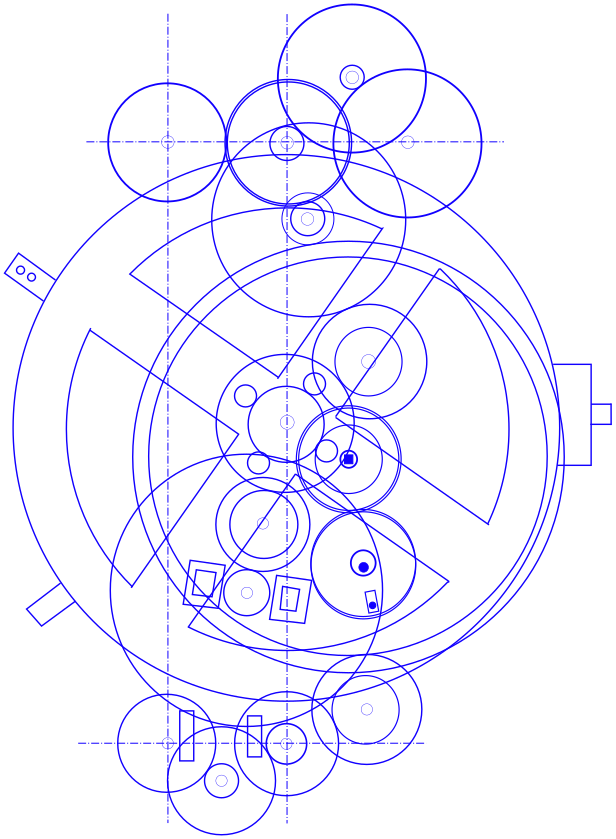
Two thousand years ago, the used bronze gears to model the sky. It compressed the motion of the Sun, Moon, planets, and eclipses into one hand-cranked machine.
That machine points to something deeply human: our obsession with . From maps to digital twins, we keep trying to understand reality by recreating it.
carried that obsession into electricity instead of gears. They simulate logic, numbers, and information through tiny switches called transistors.
Those switches store information as , simple 0s and 1s. This makes classical computers extremely good at structured tasks, from spreadsheets and graphics to everyday software.
But many real systems do not behave like neat rows of 0s and 1s. Weather, molecules, energy grids, and living cells contain too many interacting variables for classical simulation to scale efficiently.
We are also reaching the physical limits of classical chips. Transistors are now only a few nanometers wide, which makes them harder to shrink and more vulnerable to error.
take a different path. Instead of forcing every problem into fixed binary steps, they use the rules that already govern atoms and particles.
Their basic unit is the . A qubit can represent 0, 1, or a weighted combination of both until it is measured.
lets qubits hold many possibilities at once. For the right kind of problem, this means a quantum computer can explore several routes instead of testing them one by one.
connects qubits so their states become linked. This lets information and patterns spread across the system, helping quantum algorithms coordinate complex calculations.
is the constant threat: qubits lose their quantum behavior when the environment disturbs them. That is why quantum machines need extreme isolation, darkness, and near absolute-zero temperatures.
Eventually, a quantum state must be measured and turned back into readable information. Measurement is powerful, but it also collapses probabilities into outcomes, so quantum programs must be designed carefully.
If these machines become stable and scalable, their biggest impact may come from simulation. They could model systems that classical computers can only approximate or simplify.
In , quantum computers could analyze cloud cover, wind shifts, ocean currents, and temperature changes together. Better forecasting could make renewable grids more reliable and help communities prepare earlier for disasters.
is one of the most urgent risks. Future quantum computers could break today’s RSA-based systems quickly, which is why post-quantum cryptography is already being developed.
In , quantum simulations could model biology down to molecular interactions. That could speed up drug discovery, personalize treatments, and reveal causes of disease that classical pattern-matching cannot explain.
could change because chemistry is already quantum at its core. Simulating atoms directly could lead to better batteries, stronger materials, and cleaner manufacturing processes.
So the story returns to simulation. From Antikythera’s gears to quantum systems, each new tool gives us a deeper way to recreate, test, and understand reality.
may one day model ecosystems, societies, or entire worlds with far greater accuracy. The same human impulse that built the first analog computer may eventually build simulated realities of its own.